Where Cliffs Meet Tarmac
Ocean roads are celebrated for boundless horizons and romantic vistas, yet they subject the motorcyclist to two invisible, persistent adversaries: high-velocity maritime crosswinds and micro-thin marine salt glazing.
A coastal road clings to the interface between tectonic plate and ocean swell. The rock is continuously subjected to salt weathering, freeze-thaw cycles, and tidal erosion. To ride a motorcycle along these edges requires an acute awareness that tarmac laid against ocean stone is never truly stable.
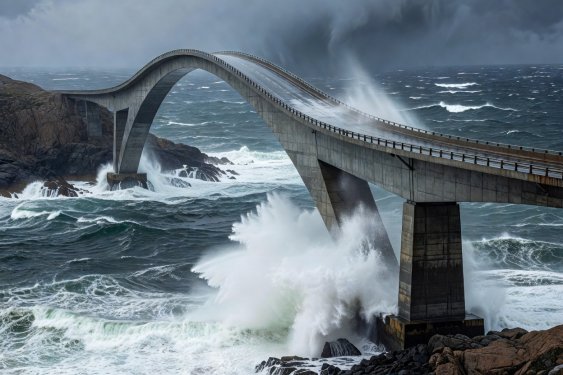
The Storseisundet Bridge on Norway's Atlantic Ocean Road during a northwesterly gale.
The Atlantic Ocean Road (Atlanterhavsveien), Norway
Spanning an archipelago of eight bridges across the Hustadvika ocean expanse, this 8.3-kilometre section of County Road 64 is renowned for its cantilevered Storseisundet Bridge. During autumn storms, Atlantic breakers crash directly across the road deck, depositing kelp, spray, and standing seawater onto the riding line.
The wind shear when riding up from the sheltered lee of an islet onto the exposed crest of the bridge can push a laden motorcycle a full meter sideways in a fraction of a second.
The Dynamic Threat: Invisible Salt Glaze
Motorcyclists understand rain, but ocean spray presents a far more deceptive hazard. In fine weather with stiff onshore winds, vaporized ocean mist evaporates rapidly upon striking warm road tarmac. The water disappears, leaving behind a microscopic crust of sodium chloride and organic marine oils.
This film is almost invisible to the naked eye. In dry conditions, it provides moderate traction; however, the moment early morning condensation or light sea fog touches it, the salt emulsifies into a transparent grease that behaves like wet ice. Cornering lean angles must be strictly moderated within coastal fog belts.
Documented Coastal Shelf Corridors
1. Chapman's Peak Drive, Western Cape, South Africa
Hugging the vertical Atlantic cliffs between Hout Bay and Noordhoek, Chapman's Peak Drive features 114 curves carved into unstable Table Mountain sandstone. The sheer precipice above drops talus directly onto the roadway, necessitating extensive rock-catch netting and half-tunnel canopies.
For riders, the hazard is compounded by sudden, severe south-easterly gusts known locally as the "Cape Doctor." These winds funnel through mountain gullies with enough ferocity to destabilize lightweight dual-sports traveling at moderate speeds.
2. Amalfi Coastal Highway (SS163), Campania, Italy
Carved into sheer limestone dropping hundreds of meters into the Tyrrhenian Sea, the Amalfi Drive connects Sorrento to Salerno. Here, the hazard is geometric confinement. The road width frequently shrinks to under five metres with no runoff whatsoever.
Touring buses negotiate blind 90-degree corners by sounding horns and taking the entire road width. A motorcycle rider must maintain absolute control at walking pace on polished, century-old limestone tarmac without putting a foot down on uneven, crumbling gutter edges.
"The horizon line over the sea is a visual trap. If your gaze follows the waves, your front wheel drifts inexorably toward the stone parapet." — Field Dispatch, Western Cape Shoreline
Defensive Posture on Coastal Shelves
To safely navigate exposed coastal corridors, seasoned riders adopt specific tactical adjustments:
- Windward Knee Anchoring: In heavy crosswinds, sticking the windward knee outward acts as a small aerodynamic rudder, stabilizing the motorcycle and reducing unwanted steering twitch.
- Deep Eye Tracking: Resisting the optical pull of the open ocean by intentionally anchoring peripheral vision to the inner white line or rock wall base.
- Post-Ride Salt Wash: Marine salt begins corroding brake calipers, rotor bolts, and chain links within hours. A fresh water rinse after ocean passes is essential mechanical preservation.